- Company Profile
Amazon, Inc. “Amazon” is a global leader in e-commerce, cloud computing, and digital advertising. Amazon closed out the 2025 fiscal year with total net sales of $716B. (Amazon.com, Inc., 2026). The scale of Amazon by the end of 2025 totaled over $818b in assets and 1.5M employees across the globe. (Bullfincher, 2026). Descriptive analytics tell a story of Amazon’s dominant position in the United States e-commerce market with a 37.6% share, which is nearly six times higher than the closest competitor. (The Synctify Team, 2026).
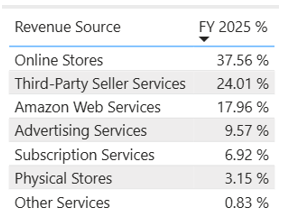
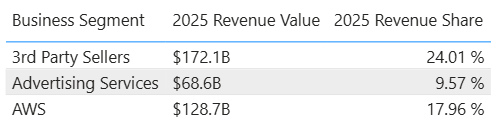
Figure 1. Breakdown of Amazon’s 2025 Revenue Generation by Source.
Source: (Bullfincher, 2026).
- Expansion Analysis
Amazon currently maintains a presence in India; however, company leadership is evaluating a strategic expansion into the rural Indian market. Today, that market consists of 650,000 villages and holds 65% of the country’s 1.4B people. There is a massive, untapped opportunity within this market as it’s currently growing at five times the rate of urban sectors. While the per-capita income at less than $1.50 per day can be characterized as ratio-level data, the sheer size of the population and growth expectation should not be ignored. (Black, 2011). Microsoft, Kellogg, and Colgate-Palmolive are all vying for the attention of the 111M middle-to-high income rural households that are expected to emerge by the end of 2025.
For a more specific look at Amazon’s global expansion strategy, it’s clear that Amazon is focused on high-velocity emerging markets. For 2025, Amazon’s online stores segment was the primary revenue driver at $269.2B, a 9.01% growth rate. To strive towards double digit growth, tapping into the rural Fast Moving Consumer Goods (FMCG) market in India, which is projected to reach $220B, presents a massive opportunity for Amazon to expand its share of the global e-commerce market. The majority of Amazon’s website traffic (87.65%) comes from within the United States, however India is number two at 1.13%, highlighting Amazon’s existence in the country already. (SimilarWeb, n.d.).
Amazon’s primary huddle for expansion is the infrastructure gap. Less than 50% of these rural households possess electricity and fulfillment logistics are hindered by poor road conditions. Amazon, however, holds significant investment power to overcome these barriers. Amazon concluded 2025 with over $86B in cash, allocated over $131B towards purchasing property and equipment with a large portion of that supporting global fulfillment and tech infrastructure, and over $818B in total assets. (Amazon.com, Inc., 2026). If necessary, Amazon has the scale to build specialized, low-power fulfillment centers that could service India’s 650K rural villages.
- New products/services
There are two primary additions to Amazon’s offerings that could launch the India expansion into rapid growth. Amazon Prime Rural (APR) and an Amazon Essentials Hygiene Kits on a subscription basis. These two offerings transition Amazon from a descriptive monitoring of the rural Indian market to actively building new services and products in a market that has a massive need for expanded fulfillment logistics and a specific product offering as mentioned.
Similar to Amazon’ well-known Prime subscription, the Amazon Prime Rural model is proposed as a subscription service at a localized, low-bandwidth position. Amazon’s subscription services revenue in 2025 reached over $49B, an 11.82% increase from 2024, and data indicates that Prime subscriber spend more than double what non-members spend. Amazon’s APR could capture the expected 111M middle-to-high income rural households in India with a lighter subscription model to boost revenue in the new market.
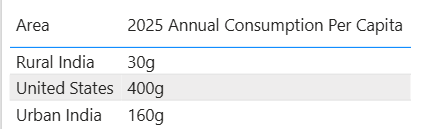
The Amazon Essentials Hygiene Kits is designed to capture the attention of the rural customers and satisfy a critical need. Quantitative analysis shows a massive consumption gap of toothpaste between rural and urban areas in India. Amazon could introduce automated, low-cost Hygiene Kits delivered via the specialized fulfillment centers throughout India’s rural countryside to gain massive traction.
Figure 2. Hygiene Consumption Gap
With the $90B in cash and cash equivalents to end 2025, Amazon has the financial stability and actionable insights to move fast on funding a rural fulfillment infrastructure throughout rural India. Converting the 65% of India’s population that lives across the rural villages, Amazon can bolster and speed up growth of the online stores segment. (Bullfincher, 2026).
- Quantitative Analysis
Black defines a frequency polygon as a quantitative data graph that is used to visualize the shape and distribution of a dataset. The construction of a frequency polygon “begins by scaling class midpoints along the horizontal axis and the frequency scale along the vertical axis. A dot is plotted for the associated frequency value at each midpoint. Connecting these midpoint dots completes the graph.” (Black, 2011). Amazon can use a frequency polygon to analyze daily global transaction volume. The visualization of that data within the frequency polygon will help decision-makers understand the frequency of high-volume surges that must be supported by Amazon’s $818B asset base. (Amazon.com, Inc., 2026). The x-axis on the polygon would represent daily global items sold and the y-axis would represent the frequency, or number of days in the calendar year. Ultimately, the graph would show stable daily operations around 12 million units of inventory daily, however, there are key surges of volume throughout the year (Prime Day and Cyber Weekend stand-out) that Amazon must plan and account for to ensure rural Indian has the infrastructure necessary to handle such large volume surges. (Michael, 2025). The collection of this data in future years will prove critical to future success as Amazon gains data on specific days within rural India (aside from Amazon sales events) that drive volume surges. (Black, 2021).
- Target Area Analysis
Amazon is recommended to prioritize middle-income rural clusters as it rolls out fulfillment expansion in rural India. Specifically, Amazon shall target states with high literacy and banking mobility. The analysis throughout this blog targets the 111M middle-to-high income rural households which are projected to emerge by the end of 2025. The total rural population of India is 910M; the focus on the 111M class makes the expansion more actionable and affordable. Within the 111M emerging population, there is income stability, financial readiness (i.e. bank/savings accounts), and digital connectivity.
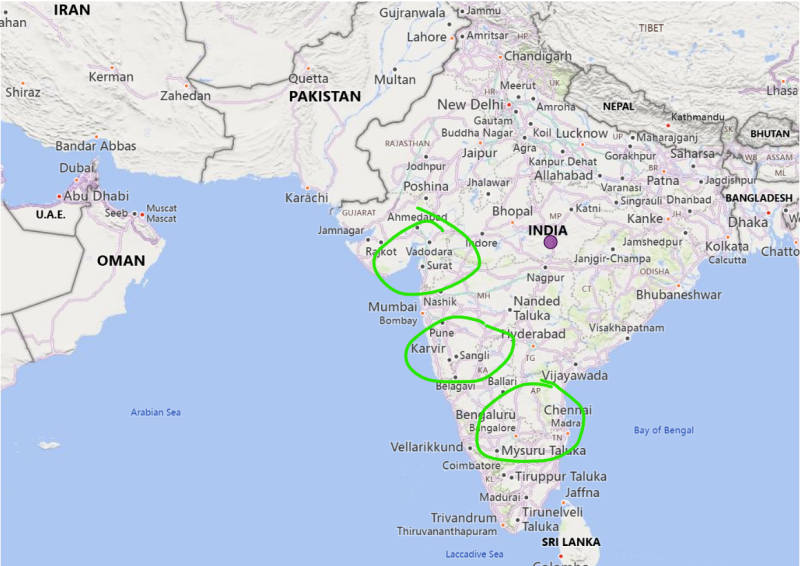
The southern and western rural clusters of India contain a large portion of the expected population growth. Amazon focusing the fulfillment expansion there would provide a higher ROI and also mitigate the risk of unpaved roads and rural poverty from other regions.
Figure 3. India Map
Bayesian Analysis
- Promotional Event
The promotional event I recommend for Amazon is in relation to the 2025 milestone of surpassing 250 million global Prime members, as well as the strategic move into rural India. (Kumar, 2025). The promotional event should offer high-value prizes, such as trips to exotic vacation destinations and business grants, to lucky winners. To qualify, members must engage with the new Prime Rural Essentials platform. The goal with this event is to increase the stickiness of the already sticky subscription services which generated $49.6B in 2025. (Bullfincher, 2026).
- Target Customers
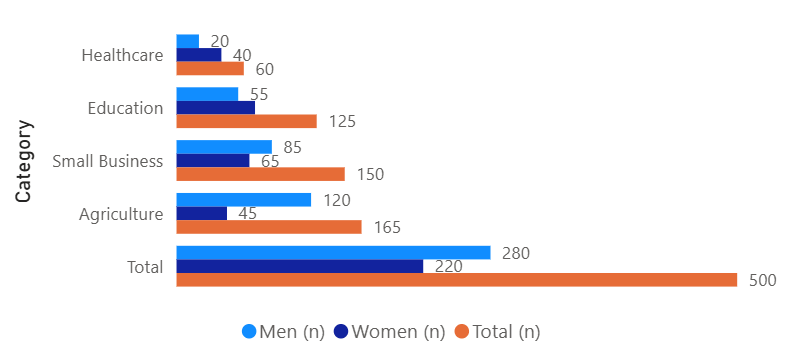
The target customers for this event are the estimated 111M middle-to-high income rural households developing in India. The customer pool can be broken down into four segments: agriculture, small business, education, and healthcare.
Figure 1. Customer Category Breakdown Projection. Sample Population (N=500).
Amazon concluded 2025 with $86.8B in cash and cash equivalents. (Amazon.com, Inc., 2026). Allocating $50M in marketing expenses to this promotional event is highly affordable and likely extremely rewarding as members are converted to Prime.
- Selected Sampling
There is a legal concern regarding a disproportionate number of men in the rural sampling. Based on the table above, the probability that a customer is a woman, P(W): 220/500 = 0.44(44%). Further, the probability that a customer in the small business category is a woman, P(W); SB: 65/150 = 0.43(43.3%). The table to the right shows the full woman probability data by customer segment.
Figure 2. Rural Customer Target Segment Distribution
From the table, it’s clear that agriculture and small business dominate the total target pool. Provided that Prime members spend an average of $1,170USD annually, those two segments are the primary engines for Amazon to continue pushing forward the 12.38% annual revenue growth. (Michael, 2025). The overall pool is 44% women, with the healthcare and education segments skewing heavier than the others toward female users. That data suggests that while men dominate the agricultural segment, women are the primary target for Amazon Prime Rural services related to digital health and education products and services. Further, non-farming income accounts for about 77% of rural revenue which backs up the importance of the healthcare and education segments which are dominated more so by women than men.

- Lottery Analysis
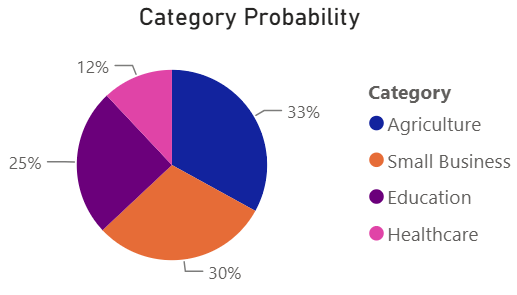
If an exotic destination trip is awarded to one person at random, the chart here shows the probability of which segment the winner comes from.
To ensure a fair drawing and avoid discrimination claims, Amazon would utilize an automated algorithm which is audited by AWS technology. Beyond the random selection of winners, final eligibility for the business grant reward should include documented productivity metrics from each seller’s portal within AWS.
- Bayesian Analysis
The Bayesian Paradigm will be implemented here to refine marketing priors based purely on 2025 consumer behavior. Amazon needs to determine the probability that a customer is a high spender (S) given they are a Prime member (P).
Calculation: P(S/P) = (0.95 * 0.10) / 0.65 = 0.146
The calculation shows a 14.6% probability that a Prime member will be a high-tier spender. I recommend Amazon uses this Bayesian inference as a driver for sending Prime Rural marketing notifications to non-members that display high-tier spender behaviors.

Decision Making at CEO Level
In 2025, Amazon.com, Inc. “Amazon” navigated a complex global environment and ultimately prioritized long-term value over short-term fluctuations. Within the year, Amazon generated $716.9B in net sales and that was largely in part to aggressive, yet calculated, decision making at the executive level. (Amazon, 2026).
- Growth Analysis
In 2025, Amazon executives faced critical decisions regarding capacity expansion to meet the massive global demand. The 37.6% share of the US e-commerce market is a number that executives strive to maintain and grow, and to do so, the company aggressively increased its physical footprint by investing $131.8B in property and equipment, an increase from $82.9B in 2024 and $52.7B in 2023. (The Synctify Team, 2026). Amazon’s infrastructure expansion provides the business with capability and elasticity to handle large volume surge events like Prime Day while maintaining the fast delivery the company is known for. (Kumar, 2025). If Amazon could not meet that demand, competitors like Walmart (6.4% share) and Target (1.9% share) who are also scaling their capabilities, could potentially claw back some of that valuable market share. (The Synctify Team, 2026).
- Personnel Analysis
The long-term strategy for Amazon involves managing a global workforce of about 1.57M employees. (Bullfincher, 2026). Amazon utilizes high-tier incentives such as stock-based compensation, totaling $19.5B in 2025, to attract and retain top tier talent from within the ranks of the business while also recruiting from outside of Amazon. (Amazon, 2026). With such a massive employee population, as well as product demand, Amazon relies heavily on $108.5B in tech and infrastructure spending. (Kumar, 2025). Investing in tech and infrastructure, along with top talent, sets Amazon up for successful handling of up to 100M items daily during holiday windows without the need to make disproportionate headcount increases and maintain a relatively lean operational spend. (Amazon, 2026).
- Cash Flow Analysis
Cash flow challenges and funding capital development have not been recent issues for Amazon. The company maintains robust liquidity to protect itself. In 2025, Amazon generated $139.5B in net cash from operating activities, ultimately providing the internal funding for the $131.8B property and equipment spend. (Amazon, 2026). The 2025 ending cash balance of $86.8B was in part successful due to Amazon obtaining $15.6B in proceeds from long-term debt. (Amazon, 2026). The financial backing that Amazon obtained in 2025 ensures that the company can continue to invest in high growth segments, like AWS ($128.7B in revenue) and advertising ($68.6B in revenue) even throughout the ups-and-downs of economic cycles. (Bullfincher, 2026).
- Expansion Recommendation
Amazon is recommended to prioritize international expansion, specifically focusing on rural India. The domestic US market is highly profitable, however the Indian countryside contains around 650,000 villages growing at five times the rate of their urban sectors. Through targeted campaigns there, Amazon can tap into a “blue ocean” of consumers. This expansion leverages Amazon’s core competency in logistics of solving last-mile challenges. Last-mile logistical success will be tough in rural India, but Amazon has the cash, talent, and ambition to nail it.
- Marketing Data Flow Diagram
The diagram below demonstrates the technical data cycle where consumers search intent ultimately drives cloud processing and advertising to drive global logistical fulfillment.

Forecast and Prediction
- Forecast Analysis
In comparison to the downturn of Piaggio, Amazon faces a strategic challenge that could also lead to a downward spiral, as the company is focused on aggressive expansion and high capital expenditure. If Amazon does not realize ROI, a downward trend could materialize in the coming years. Between fiscal years 23 and 25, Amazon’s property and equipment investment spend elevated from $52.7B to $131.8B. (Amazon, 2026). That spend heavily outpaces the 12.38% annual revenue growth. (Amazon, 2026). Though Amazon reported $716.9B in net sales in 2025, it also saw $15.6B in new long-term debt proceeds which resulted in a total long-term debt of $65.6B. (Bullfincher, 2026).
Amazon is looking to expand into rural India. A failure to achieve projected returns from an initiative which will require massive investment in infrastructure and logistics could mirror Piaggio’s “crushing debt” dilemma. Global market saturation, or stabilization of AWS revenue, could also lead to the new infrastructure and logistics spend in India exceeding operational cash flow. (Bullfincher, 2026).
- Risk Avoidance
The implementation of rigorous risk avoidance and risk prevention strategies is critical for Amazon to prevent an event such as a total logistics collapse in an emerging market like rural India. (Arsham, 2015). Expanding into rural India should consist of a phased rollout which specifically targets the emerging 111M middle-to-high income rural households.
Risk assumption, through use of Amazon’s localized supply chain, and risk reduction, through construction of specialized, low-power fulfillment centers to address the electricity gap, are key measures for Amazon’s expansion. Further, transitioning from descriptive monitoring to deploying the proposed Amazon Prime Rural ensures that Prime members remain the primary drivers of revenue during the expansion.
- Deming’s 14 Points
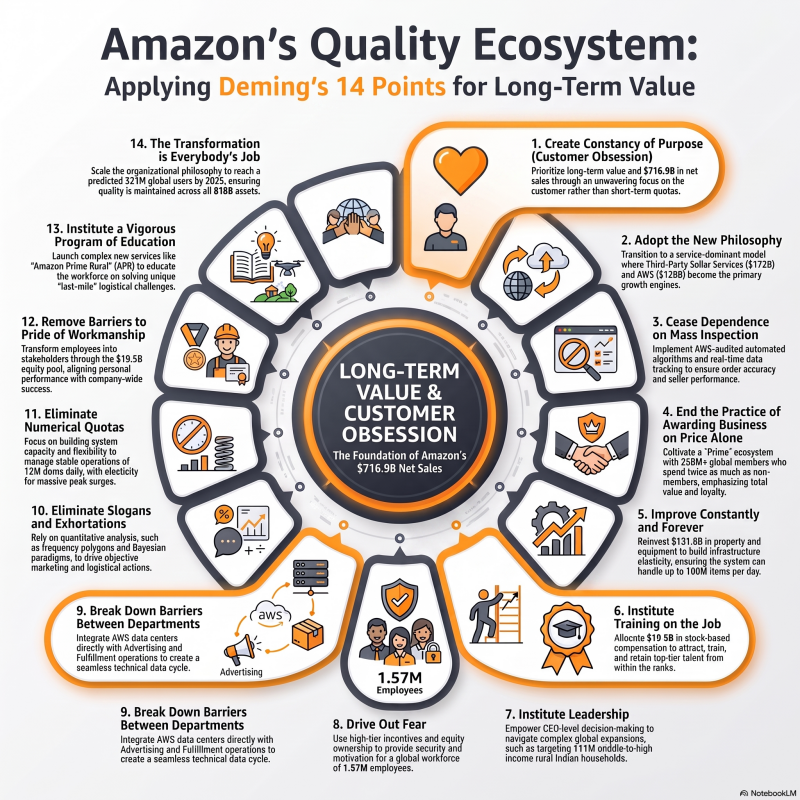
To maintain long-term quality and operational excellence within its processes, Amazon can apply Deming’s 14 points, and by doing so, can protect its $818B asset base and maintain its 37.6% e-commerce market share. The graphic below, created by Google NotebookLM, showcases how Amazon can apply each of Deming’s 14 points.
- Six Sigma
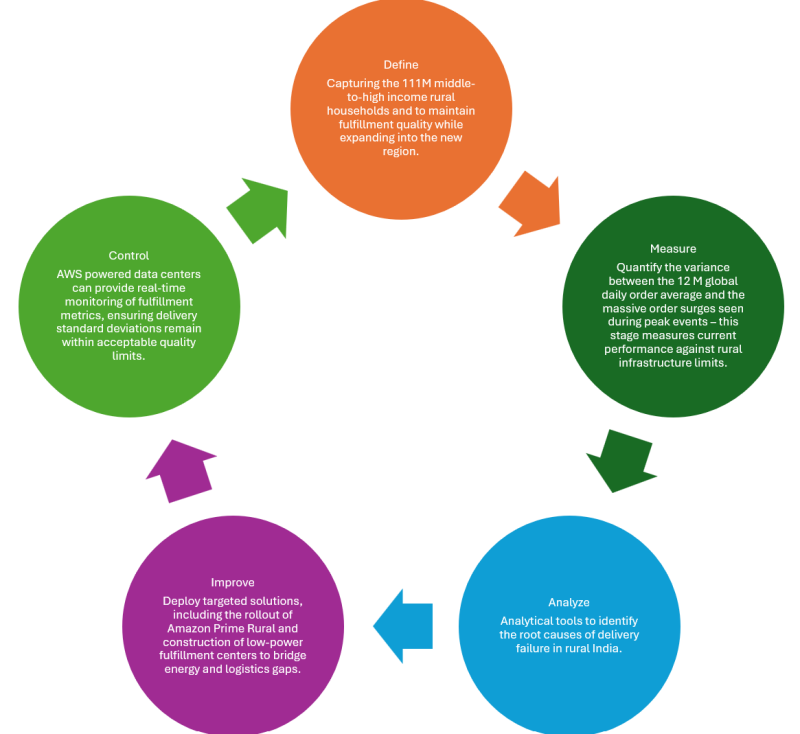
To optimize the last-mile fulfillment process in rural India, Amazon can implement Six Sigma methodologies to reduce variability and delivery defects. (Black, 2011). The DMAIC (Define, Measure, Analyze, Improve, Control) framework within Six Sigma is critical for Amazon to systematically address infrastructure hurdles within the region. (Black, 2011). The graphic below demonstrates the DMAIC framework Amazon should focus on to optimize fulfillment and reduce defects in last-mile delivery.
- Conclusion
Amazon has established itself as a global leader in e-commerce and currently holds a 37.6% share of the US e-commerce market and reported $716.9B in 2025 net sales. (Amazon, 2026). Amazon’s pivot toward high-margin net service sales driven by advertising (22.1% growth) and AWS ($128.7B revenue) highlights that long-term value is already rooted in its ecosystem. (Bullfincher, 2026).
Amazon’s $131.8B investment in property and equipment calls for discipline management to ensure marketing and Prime customer analytics drive customers in rural India towards converting to Amazon Prime Rural. Through a focus on Six Sigma quality control, Deming’s 14 points, and avoiding risk, Amazon can leverage its $86.8B in cash to solve logistical challenges and continue driving global market dominance.
Create Your Own Website With Webador